
By David Mullen
When a family-run company goes from a value of $140 million to an estimated $13 billion in 36 years, it would appear to be a case study of unparalleled success destined for business textbooks everywhere. But if a football team keeps running the same game plan over and over again, the element of surprise disappears, success wanes and the action on the field becomes predictable. It’s just the same old song.
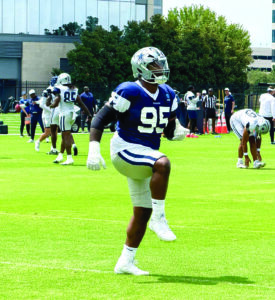
Photo courtesy of the Dallas Cowboys
The main takeaway from the exhaustive eight-episode Netflix series, “America’s Team: The Gambler and His Cowboys,” is that Dallas owner Jerry Jones has made the Cowboys all about him. He bought the team to have the job as president and GM, despite no background in sports management. He made clear that his team — “America’s Team” — would remain in the Jones family forever.
Jones may be the best team president in NFL history, while being the worst GM at the same time.
On August 28, Jones ended a contract “hold-in” between the team and their best player. Jones traded arguably the team’s best defensive player ever – defensive Micah Parsons – to the Green Bay Packers for two future first round draft choices and defensive tackle Kenny Clark. Cowboy fans have heard that tune before.
In his first four years with Dallas, Parsons, a standout player at Penn State and the Cowboys’ first round draft pick in 2021, was NFL Defensive Rookie of the Year, a four-time Pro Bowler and one of two players in NFL history to have at least 12 sacks in his first four NFL seasons. The other is Hall of Famer Reggie White.
Immediate comparisons to the February trade of Luka Doncic by the Dallas Mavericks to the Los Angeles Lakers surfaced. While both trades shocked Dallas sports fans and rocked the sports world, Doncic’s departure was not based on money. With Parsons, it was all about the Benjamins.
Parsons is 26 years old. He was born in 1999. The value of honoring a contract, a discipline that many people grew up with, has long been dispatched by a social media driven me-generation. No doubt that Parsons has a serious case of self-worth. He demanded a trade through a social media post.
Unlike other notable Cowboy holdouts, Parsons apparently wanted to remain with the team. On ESPN on September 2, Parson’s agent David Mulugheta, who Jones refused to talk to during Parsons’ hold-in, said: “I think the most important thing is that Micah wanted to be a Cowboy.
He grew up cheering for the Cowboys, wore the blue and white at Penn State, wore it in the NFL with the Dallas Cowboys. He wanted to be a Cowboy. We did everything we could for him to remain a Cowboy.”
In the first 29 years of the franchise when the Cowboys were owned by someone not named Jones, the 1971 holdout by RB Duane Thomas was the most discernable contract dispute in Cowboys history.
In the early years of the NFL, players were underpaid, did not have legal representation in contract negotiation and had virtually no options if unsatisfied with their current salary. Thomas made $18,000 in 1970. With a signing bonus, Thomas made $43,000 or about the same amount as a rental fee for a suite on the Hall of Fame level at AT&T Stadium for one game. Thomas refused to report to training camp or speak to coaches, players and the media. He played in 1971 for the eventual Super Bowl Champion Cowboys and was traded in the following offseason.
And then along came Jones.
Since Jones bought the team in 1989, prominent contract disputes between Jones and Cowboy players include a contract dispute with star running back Emmitt Smith. Smith had helped lead the Cowboys to a Super Bowl victory in the 1992-1993 season. Smith wanted to be paid like the top running back in the NFL, which he clearly was. A holdout led to the defending Super Bowl Champions opening the 1993 season without Smith and losing their first two games.
Jones and Smith played hardball. Vocal defensive star Charles Haley said that the Cowboys were playing an ineffective rookie while the best running back sits out. Jones backed down, signed Smith before Game 3 and the Cowboys went on to win their second consecutive Super Bowl and second of three in four years.
In addition to Smith and Parsons, Jones has had highly visible contract disputes with QB Dak Prescott, guard Zack Martin and WR CeeDee Lamb. All of the players eventually signed contract extensions. Parsons, in the final year of his contract, was traded. Green Bay immediately signed Parsons to a five-year, $210 million contract with $120 million guaranteed.
Both Jones and Parsons share a common personality trait that the football world revolves around them. The financial and emotional investment made by Cowboys fans around the world be damned. But Jones is to blame for Parsons playing in Packers green and gold this season, almost assuring another losing season for the Cowboys. Dallas has not returned to the NFC Championship since 1996.
Unfortunately, for the throng of Dallas Cowboys fans everywhere, the road to personal success for the Jerry Jones family has been filled with anguish for the legion of supporters that have paved the way to the family’s pot of gold. It’s just the same old song.

Cowboy fans familiar with Jones’ plan added by whiterocklakeweeklyadmin on
View all posts by whiterocklakeweeklyadmin →