
By Beth Leermakers
“Relax. You’re making your foster dog more anxious,” says my dog trainer while we’re introducing two dogs on a leash walk. Relaxing isn’t easy when I’m worried the dog I’m leading will react negatively to the other dog.
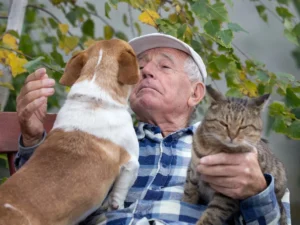
Photo courtesy of Atlantic Shores
Dogs sense when their people are stressed or upset, and they may respond in kind. On the flip side, they often react positively when you’re relaxed and happy. Research shows that dogs — and cats — can detect a variety of human emotional cues, including facial expressions, vocal tone and scent. Dogs have developed remarkable social skills through their long relationship with humans, making them good emotional support and service animals. Although cats may respond more subtly, studies suggest they also pay attention to people’s emotional signals.
A recent study found that human smiles trigger distinctive activity in specific parts of the canine brain — and that dogs can tell apart several negative expressions, including anger, sadness and fear. Researchers used brain scans and machine-learning analysis to examine how dogs responded when shown photographs of unfamiliar people displaying different emotions.
In the first experiment, researchers scanned the brains of eight dogs while they viewed pictures of people displaying happy or neutral expressions. When the dogs saw happy faces, activity increased in the temporal cortex (associated with higher-level cognitive processing) and caudate nucleus (involved in reward). The researchers said the activity in the caudate nucleus suggests that happy human faces may have emotional significance for dogs.
The researchers then showed 12 dogs photographs of people displaying happiness, anger, fear and sadness. Machine learning was used to analyze the resulting patterns of brain activity.
The results showed that dogs weren’t simply sorting expressions into two categories — “positive” and “negative.” Brain scans revealed different patterns of neural activity for fear compared with anger and sadness.
Dogs are skilled at observing human faces, but they don’t rely on facial expressions alone to interpret emotions. They can combine visual information with body language, tone of voice and even odors associated with different emotional states. Research has shown that dogs can integrate facial expressions and vocalizations when distinguishing positive and negative emotions.
Dogs use their extraordinary sense of smell to detect changes in our emotional state. Sadness, fear or stress trigger the release of hormones (such as cortisol and adrenaline) that are excreted in tears, sweat, and our breath. Dogs’ highly sensitive noses can detect subtle differences in these odors.
Dogs also notice changes in our behavior. A person who is sad might move more slowly, speak differently, avoid eye contact or adopt a different posture. Dogs constantly watch their people, using multiple sources of information to determine how we’re feeling.
Cats have historically received less attention than dogs in emotion research, but studies suggest cats also detect human feelings.
One study found that cats can recognize human emotions through visual and auditory observations. In the experiment, cats were shown human faces displaying happiness or anger while hearing corresponding vocalizations (laughing or growling). The cats looked longer at the face whose expression matched the sound they heard (e.g., a happy face and laughter). They also displayed more stress-related behaviors when exposed to angry human signals. Cats may also respond to emotional information carried through scent. In another experiment, 22 cats were exposed to odors collected from three unfamiliar men who experienced fear, happiness, physical stress or a neutral state. The study revealed that cats’ behaviors changed significantly based on the emotional odors presented, particularly fear-related scents. When exposed to the “fear” odor, cats exhibited more severe stress-related behaviors compared to when they were exposed to “physical stress” and “neutral” odors.
Interestingly, the cats did not clearly distinguish between fear and happiness odors. Researchers suggested that cats may need visual and auditory cues in addition to scent to fully interpret positive emotions — or they may simply respond to the overall level of arousal associated with an odor instead of differentiating between positive and negative emotions.
Our pets may not understand human emotions the same way we do, but they pay attention to the signals we send. Dogs are especially good at combining facial, vocal, behavioral and scent cues, while cats can also integrate visual, auditory and olfactory information.
To strengthen your bond with your cat or dog:
Communicate calmly. Use steady tones and try not to yell at your pet when you’re angry or stressed.
Look your pet in the eye. Gentle eye contact releases oxytocin (the bonding hormone) in both dogs and humans.
Monitor and control your own energy. If you’re worried about taking your fearful cat or dog to the vet (or introducing her to a new companion), breathe slowly and deeply. Your pet will notice the difference. Shower before snuggling your cat or dog. Wash away those fear/stress odors after a difficult day. Focus on your breathing while you’re at it.
Many say happiness is contagious, for people and pets. If that is true, which I believe it is, that also means that anxiety can be “caught,” too. So, relax and breathe. Because our furry friends do not enjoy feeling anxious, either.

Human emotional cues affect how pets react added by whiterocklakeweeklyadmin on
View all posts by whiterocklakeweeklyadmin →