
By Taylor Mayad Powell
The Meadows Museum and Bridwell Library at SMU have received a major gift from the family of Robert Tonti and Tina Tonti, who amassed an extraordinary collection of modern, postwar and contemporary art over the past three decades. The newly acquired works significantly expand the holdings of the Meadows Museum, which houses one of the largest and most comprehensive collections of Spanish art outside Spain.
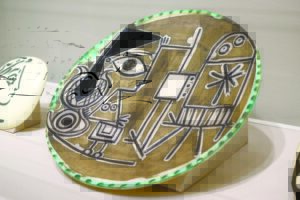
Photo courtesy of The Meadows Museum
The gift introduces the museum’s first drawing by Pablo Picasso (1881–1973), its first acquisitions by Eduardo Chillida (1924–2002) and rare first-edition plates by Francisco de Goya (1746–1828). Several pieces will make their public debut in Picasso Beyond the Canvas, on view now through Jan. 24, 2027, at the Meadows Museum.
“We are deeply grateful to the Tonti family for their remarkable generosity and stewardship of these works,” said Amanda W. Dotseth, Linda P. and William A. Custard director of the Meadows Museum. “The most meaningful gifts are those that continue to reveal new stories over time. By preserving and sharing these works, we ensure that they remain accessible to future generations while deepening our understanding of the artistic traditions that have shaped Spain and continue to resonate around the world.”
In addition, the Tonti family gifted 33 works on paper by American artist Jasper Johns to the Bridwell Library. The selection spans more than four decades, from 1969 to 2012, and includes lithographs, etchings, aquatints and other prints featuring some of Johns’ most recognizable motifs, including numbers, flags, maps and targets. The gift enriches the library’s collections while also creating new opportunities for teaching, research and scholarly engagement across the University.
“This remarkable gift represents an exciting addition to Bridwell Library’s collections and to the academic resources available across the University,” said Anthony Elia, director of Bridwell Library. “Students and scholars will have the opportunity to study original works by one of the most influential artists of the modern era while exploring connections across a wide range of disciplines. These works will serve as valuable resources for teaching, learning and discovery for years to come.”
Among the nearly 40 works donated to the Meadows Museum are its first drawing by Picasso, Tête de femme (1963), along with 15 ceramic pieces by the artist and the linocut Grande tête de femme (1962–63). The museum’s Chillida acquisitions include a complete set of 16 woodcuts from his 1973 series Beyond (Más allá) and the large-format engraving Bikaina XVI (1988). Additionally, the Tonti family donated four plates from the 1824 first edition of Francisco de Goya’s Follies (Los disparates).
Exploring a vital yet often overlooked aspect of the artist’s career, Picasso Beyond the Canvas features 18 ceramic objects from the Tonti family, along with gifts from Catherine B. Taylor and the estate of Stephen Kahn (transferred to the Meadows Museum from the Bywaters Special Collection). Dating from 1953-1963, the objects were created at the height of Picasso’s ceramic production and reflect the remarkable breadth of his experimentation in clay. Many will be displayed together publicly for the first time.
Picasso began working extensively in ceramics in the aftermath of World War II at the famed Madoura pottery studio in Vallauris, France. Drawn to the immediacy and accessibility of clay, he embraced ceramics as a democratic medium. Unlike his paintings, ceramic works could be produced affordably and circulated widely, aligning with his postwar interest in creating art for a broader public.
Although critics often dismissed these works as decorative or experimental, Picasso approached ceramics with the same inventiveness that characterized his paintings and sculpture. Working in clay gave him a new way to merge painting, printmaking and sculpture into a single artistic form.
Highlights of Picasso Beyond the Canvas include Face with Pinched Nose (Visage au nez pincé) (A.R. 414) (1959), a vividly decorated ceramic plate that demonstrates Picasso’s playful manipulation of the human face, and Woman Lamp (Lampe femme) (A.R. 299) (1955), an object that is at once a utilitarian vessel and an expressive female figure. Together, the works illustrate Picasso’s exploration of volume, line and surface during one of the most innovative periods of his career.
“This exhibition invites visitors to see Picasso through a different lens,” said Sofia Penny, curatorial assistant at the Meadows Museum. “Although often overshadowed by his paintings and sculpture, Picasso’s ceramics reveal some of the most inventive and experimental aspects of his artistic practice. Through clay, he expanded the possibilities of creative expression while embracing a medium that reflected his commitment to making art accessible to a wider audience.”
Together, these works reveal Picasso’s ceramics as an essential part of his artistic legacy and a major contribution to 20th-century art.
This exhibition has been organized by the Meadows Museum, SMU, Dallas and is funded by a generous gift from The Meadows Foundation.
The Meadows Museum is located on the SMU campus at 5900 Bishop Blvd. in Dallas. For more information, visit meadowsmuseumdallas.org.

Donation enriches museum’s holdings added by whiterocklakeweeklyadmin on
View all posts by whiterocklakeweeklyadmin →