
By Theresa Hunt
For nearly 63 years, viewers around the world had seen the smiling young woman standing along President John F. Kennedy’s Dallas motorcade route, but few knew her name or the story behind those brief seconds of film. Today, she is known as Joan Jackson, a 94-year-old resident of CC Young Senior Living whose memories have added a personal chapter to one of the most closely documented days in Dallas history.
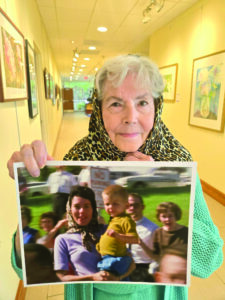
Photo courtesy of Joan Jackson/CC Young
CC Young recently welcomed Stephen Fagin, head of curatorial at The Sixth Floor Museum at Dealey Plaza, for a screening of “The Last Two Days,” a 20-minute film documenting President Kennedy’s final trip through Texas in November 1963. Following the film, Fagin sat down with Jackson to discuss what she witnessed that day, and how her identity was finally connected to footage that has appeared for decades in numerous news reports, documentaries and films.
The program at CC Young was about more than one historic moment. It reflected
CC Young’s broader commitment to creating meaningful opportunities for its residents and community friends to remain intellectually curious and engage with historic events that have shaped their lives. In this case, connecting one resident’s story with the historical record and encouraging others to contribute their memories.
Jackson moved to Dallas around 1949 and worked downtown before marrying and raising a family. On the morning of Nov. 22, 1963, a neighbor invited her to see the presidential motorcade. Jackson initially declined because of the rain, but her neighbor called again when the weather began to clear. “The sun’s coming out. Let’s go,” Jackson remembered her saying.
The two women gathered their young sons and drove to Turtle Creek Boulevard, following the motorcade route published in the newspaper. Jackson’s neighbor, Jean Wortham, brought a camera but was holding her 3-year-old son, Gary. Jackson offered to hold him so Wortham could move closer to the street and take a photograph. As the motorcade approached, Jackson heard the crowd grow louder. President and Mrs. Kennedy passed in an open convertible, with the first lady’s bright pink suit standing out in the sunlight.
Unbeknownst to Jackson, White House photographer Thomas Atkins captured her smiling while holding Gary. She appears for a few seconds, but the rare color footage has been used in major documentaries and the opening sequence of Oliver Stone’s 1991 film “JFK.”
After the motorcade passed, Jackson and Wortham returned to their car and turned on the radio. Before they reached home, they heard that the president had been shot.
“We both looked at each other at the same time and said, ‘But we just saw him,’” Jackson recalled.
The news carried additional emotional weight for Jackson. Her husband had died earlier that year, leaving her with two children. As she watched the events of that weekend unfold, she felt a personal connection to Jacqueline Kennedy’s grief.
“I immediately thought, I know how she feels because I’ve lost my husband too,” Jackson said.
Jackson recognized herself in the footage years later while watching television but did not immediately tell her family because she thought it might sound like bragging. Her daughter eventually spotted the clip independently. Decades later, Jackson’s daughter Sherry contacted Fagin, finally giving historians the name behind the familiar face.
Jackson also contributed new pieces to the historical record. She donated to The Sixth Floor Museum the scarf she wore along the motorcade route, which she had kept for more than six decades without considering it a historical artifact. She also donated the only known print of the photograph Wortham took as President Kennedy passed along Turtle Creek Boulevard.
Fagin previously recorded Jackson’s story as part of The Sixth Floor Museum’s Oral History Project, which has preserved more than 2,700 firsthand memories of President Kennedy and the assassination or reflections of significant events and social movements of the 1960s. During the program at CC Young, he invited other residents and guests to contribute their voices to the collection and offered to return to campus to record their stories individually. When asked what keeps her active and engaged at 94, Jackson pointed to the everyday sources of purpose in her life. “I like to stay busy. I like to volunteer, do things, activities that make me feel good, and I have a great family that I love, and they love me,” Jackson said. “And I love it here at CC Young. This is one of the best moves I ever made.”
What began as a last-minute decision to attend a parade has become part of the museum’s permanent record. At CC Young, it also served as a reminder that history lives in neighborhoods, families and the memories residents carry with them. When given the time and space to be shared, those stories can connect generations.

Resident’s memories become part of Dallas history added by whiterocklakeweeklyadmin on
View all posts by whiterocklakeweeklyadmin →