
By Josh Ortega
In sports things are always evolving. Whether its tactics, rules or divisions, aspects are always changing.
This week, the Big 12 Conference wrapped up its 2026 Phillips 66 Men’s Basketball Tournament at the T-Mobile Center in Kansas City with No. 2 Arizona (32-2, 16-2) hoisting the Big 12 trophy for the first time in program history with a 79-74 win over No. 5 Houston (28-6, 14-4). The Wildcats’ first Big 12 title capped off a wild week for the conference, including a mid-tournament switch from a digital court to traditional hardwood after player feedback.
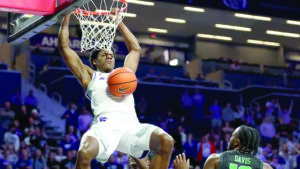
Photo courtesy of Kansas State
The Big 12 took a shot at showing fans what the future of basketball could look like with a new digital court. The conference debuted a basketball court made entirely out of LEDs and glass at both legs of its men’s and women’s basketball conference tournaments.
The Big 12 partnered with ASB GlassFloor to have the digital court serve as both a fully functioning basketball court that met the standards of traditional hardwood and also served as one giant screen for different multimedia purposes. It included responses to in-game actions, a map of the United States and a mini running track at mid-court.
The conference announced the use of the court for both tournaments a month before both competitions in a statement:
“The digital court enhances the fan experience both in-arena and on broadcast. It enables real-time branding, in-game activations and data-driven visuals that seamlessly adapts across basketball and other sports without compromising performance, durability or student-athlete safety.”
The same type of digital court had been previously used at NBA All Stars in 2024, and in Europe for different FIBA sanctioned competitions. However, the court had never been used for an official competition in the United States until now at the conferences’ tournaments.
The Big 12 received praise for the court by team officials across the conference when the announcement went live but come tournament tip-off time concerns began to arise.
The court received mixed reviews on the feel of it during the women’s tournament. Multiple players commented on the difference the playing surface had compared to traditional hardwood. BYU sophomore forward Brinley Cannon talked about the court after BYU’s second round win over Houston.
“I was sliding a little bit,” Cannon told reporters during the post-game press conference. “It’s really cool looking, but it’s definitely a little bit of a different feel you have to get used to.”
Other players also voiced their opinions about the digital court throughout the tournament, with the floor lasting the full length of the event. Big 12 Commissioner Brett Yormark addressed the reviews of the floor during the opening press conference of the men’s tournament.
“Listen, when you innovate and you want to disrupt in a positive way, you’re never going to get a 100 percent buy in, but I have received a lot of positive feedback,” Yormark said. “It’s really interesting whenever we innovate. We really encourage all key stakeholders to give us their feedback, and we listen intently. So, I am very happy about where we are, but we are monitoring that feedback to make the necessary adjustments where we can.”
The noise continued to grow at the start of the men’s tournament. On the opening day of the tournament multiple players raised concerns about the digital court, including Kansas State junior forward Taj Manning.
“It’s pretty bad to be honest — it’s slippery,” Manning said after the Wildcats opening loss to BYU. “The lights caused Khamari (McGriff) to get a migraine. It’s a bad floor; they shouldn’t bring it back, if you want my opinion.”
The tip of the iceberg came when Texas Tech sophomore guard Christian Anderson slipped on the floor and was injured during Texas Tech’s 75-53 loss to Iowa State. Anderson slipped while trying to receive an inbound pass in the second half. He did eventually come back to the bench but did not re-enter the game.
Anderson did confirm he would be OK after the game but did say that the court was “a bit slippery.”
Anderson could have also slipped on a hardwood floor but, between that injury and the laundry list of voiced concerns from players and coaches, the conference opted to make a change Thursday night. Just after the end of the final quarterfinal game. Commissioner Yormark released a statement that the conference would change floors.
“After consultation with the coaches of our four Semifinal teams, I have decided that in order to provide our student-athletes with the greatest level of comfort on a huge stage this weekend, we will transition to a hardwood court for the remainder of the Tournament,” Yormark said. “We look forward to a great Semifinals and Championship Game.”
The final three games were played on traditional hardwood. Not all comments on the court were negative; many players and coaches voiced positive reviews of the digital court despite its kinks.
The saga does raise questions, however. What does the relationship between digital technology and live sports look like in the future? How will conferences and leagues learn from this? Will the digital court ever come back? Only time, and The Big 12, will tell.

Big 12 takes shot at the future of floors added by whiterocklakeweeklyadmin on
View all posts by whiterocklakeweeklyadmin →