
By Beth Leermakers
Black cats are often the stars of Halloween decorations — and costume parties. With their sleek coats, glowing eyes and mysterious nighttime habits, black cats seem almost tailor-made for spooky season. But cats haven’t always been considered supernatural creatures.
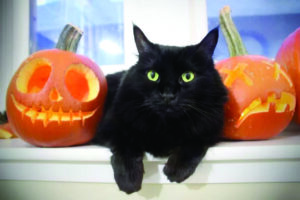
Photo courtesy of Schertz Animal Hospital
For thousands of years, cats were admired and even worshipped. So how did these once-sacred animals become associated with witches, bad luck and evil? Keep reading to discover the shifting perception and portrayal of cats throughout history.
Long before black cats became a Halloween icon, they were honored by ancient Egyptians. In 2800 B.C., Egyptians respected cats of every color, including black cats. They worshipped Bastet, a cat goddess considered a guardian against evil spirits and disease. Ancient Egyptians considered cats magical creatures who brought good luck to their owners. Domesticated cats were treated like royalty, fed well and dressed in jewels. Some cats were even mummified after they died. Harming or killing a cat resulted in severe punishment, including being sentenced to death.
Black cats didn’t have a sinister reputation in other parts of the world, either. During the early Middle Ages, cats were considered good luck symbols. In the eighth century, sailors and fishermen kept black cats aboard ships as sailing companions, good luck charms and effective ratters. Some sailors even watched their cats’ behavior for clues about the weather.
Later in history, cats shifted from being adored and valued to being hated and feared. During the Middle Ages in Europe, cats were often killed because they were considered evil. Some people blamed cats for spreading the bubonic plague and used that as a reason to kill them. Ironically, with fewer cats to control the rodent population, the plague spread rapidly.
In Scottish folklore, the Cat-Sìth was a mysterious black cat-like fairy with a white spot on its chest. Some people believed the Cat-Sìth was a witch that could transform into a cat and then back into her human form nine times. If the witch turned into a cat for the ninth time, she would remain a cat for the rest of her life. The Cat-Sìth was the origin of superstitions (like cats having nine lives) and mythical associations between black cats and magic, Halloween and bad luck.
The Cat-Sith was particularly connected with death. According to legend, the creature lingered around graveyards at burial time, hoping to steal souls that had not yet fully passed from the world of the living. Special guards watched over the soon-to-be-buried bodies — dancing, playing music and telling riddles to distract the Cat-Sìth and keep them away until burial.
The Cat-Sìth was closely associated with Samhain, the Gaelic pagan festival celebrated from October 31 to November 1 to mark the harvest. According to tradition, the boundary between the physical world and the spirit world breaks down during Samhain, allowing greater interaction with Otherworld residents. During Samhain people left a saucer of milk outside their house for the Cat-Sith, hoping the creature would bless the family for the coming year. If household members didn’t put out milk, the Cat-Sith would curse the family, drying up the udders of the family’s cows (so they didn’t have any milk, either).
As Christianity gained influence in medieval Europe, cats became linked with witchcraft and the supernatural. By the 12th century, stories portrayed cats as participants in satanic rituals. Medieval accounts described the devil appearing as a black cat. In the 13th century, an official church document issued by Pope Gregory IX declared black cats to be an incarnation of Satan.
In colonial America, black cats were sometimes believed to be witches’ familiars — supernatural helpers used for spying or other forms of dark magic. A black cat accompanying a witch eventually became one of Halloween’s most recognizable symbols.
Today, most people don’t believe that black cats are witches or agents of the devil. But the sleek felines still take center stage during Halloween, appearing in decorations and costumes, and in TV shows such as “Sabrina the Teenage Witch.”
Unfortunately, the old superstitions can still have real-world consequences. Black cats are often the last to be chosen for adoption. Animal shelter staff warn people to keep their cats (especially black ones) indoors on Halloween, to protect them from evildoers.
While draping jewels around a cat’s neck may seem a bit extreme, there are plenty of other ways to respect, protect and support black — and other colored — felines:
• Keep your cat(s) safely indoors — year-round.
• Put water out in your yard for community and owned outdoor cats.
• Feed community cats in your neighborhood.
• Provide simple shelters for outdoor cats during the winter.
• Donate supplies (newspapers, kitty litter, cat toys) to Dallas Animal Services or another shelter.
• Volunteer to socialize cats at DAS or another shelter.
• Foster a cat for a shelter or a rescue group.
Happy Halloween!

Black cats often last chosen for adoption added by whiterocklakeweeklyadmin on
View all posts by whiterocklakeweeklyadmin →