
By Beth Leermakers
“Is Snoopy house trained?” ask foster parents when deciding whether to welcome a rescue dog into their home. Dogs who’ve spent months in a shelter — with infrequent if any potty breaks — will probably need at least a refresher on housetraining. A dog who was house trained in a previous home may need to learn the bathroom routine in a new environment with different sights, smells and expectations.
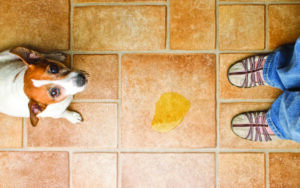
After spending four months in the shelter, Moonpie (my nine-month-old foster puppy) wasn’t concerned about where to “go.” After drinking lots of water, he urinated in the living room 30 minutes after he’d gone outside. It was time to go back to house training basics. With patience, consistency and positive reinforcement, puppies or adult dogs can learn where they should — and shouldn’t — go to the bathroom.
Establish a Routine and Reward the
Desired Behavior
Consistency is crucial. Establish regular times for meals, exercise and potty breaks. Puppies under eight weeks old may need to go outside every one to two hours while their bladder control is still developing.
Feeding meals at consistent times (instead of free feeding) makes potty habits more predictable. Establish regular mealtimes and take your dog outside shortly after eating. Digestion takes eight to 12 hours, so post-breakfast poop is the remains of last night’s dinner. Eating triggers the gastrocolic reflex, signaling the colon to make room by pushing along whatever was already in the system.
When you take your dog out, go to the same potty area and say, “Go potty” or “Bathroom” each time. Eventually your dog will associate the words with the desired behavior.
When your dog eliminates outside, immediately offer praise and/or a treat or toy. Reward your pup immediately so she makes the connection between going outside and receiving something desirable. Take your dog outside on a leash (even in a fenced yard) so you’ll be right there to praise her right away.
Learn Your Dog’s Signals
Your dog might whine, pace, become restless, sniff the floor, circle, bark, hover near or scratch at the door or suddenly change activities. Learn your dog’s signals and take her outside promptly when you notice them. Keep your dog confined in the room with you so you see when she needs to go. Some people put a leash on the dog (inside) and always keep her close. However, this approach doesn’t work when Moonpie is wrestling with his friend Snoopy.
Don’t count on your dog telling you when she needs to go. Some dogs, like Moonpie, don’t give an obvious warning signal. Until you understand your dog’s habits, follow your schedule and take your dog outside often. Moonpie and I go out (for a few minutes only, due to the heat) every 30 minutes when he’s loose in the house.
Crate Training Works
A crate is a terrific house-training tool for puppies and older dogs. Dogs generally don’t want to eliminate where they sleep, so an appropriately sized crate can help prevent accidents when you can’t supervise your dog. A crate also gives your dog a quiet, comfortable place to rest. Moonpie doesn’t have accidents in his crate, even overnight.
Follow these basic crate-training guidelines:
• Choose the “just right” size. The crate should be large enough for your dog to stand, lie down and turn around comfortably, but not so big that he can use one area as a bathroom and another as a sleeping space. The MidWest Homes for Pets LifeStages crates have a movable divider panel so you can adjust the crate size as your puppy grows.
• Make it comfortable. The crate should feel like a safe, calm space. Put a crate mat, bed, towel or blanket in the crate, and provide water and plenty of chew toys.
• Never use the crate as punishment. Your dog should view his crate as a secure place to relax — not something to fear.
• Exercise your dog before crating. A potty break and some age-appropriate exercise before crate time can help your dog settle.
• Provide frequent potty breaks. A crate is not a substitute for taking your dog outside. Puppies and dogs who are still learning may need frequent opportunities to eliminate. If you’ll be gone for several hours, arrange for someone to give your dog a midday potty break.
How to Handle Accidents
Accidents are part of house training, so don’t yell at or punish your dog. If you catch him in the act, calmly interrupt him and immediately take him outside. If he finishes outside, reward him.
If you find an accident after the fact, don’t punish your dog. He won’t understand why he’s being scolded. Punishment can create fear and confusion rather than teach the desired behavior. Rubbing your dog’s nose in the mess doesn’t work.
Clean up accidents thoroughly. Dogs can detect odors that humans can’t, and lingering urine or fecal smells may encourage them to return to the same spot. An enzymatic cleaner designed for pet accidents (I swear by Nature’s Miracle) breaks down and removes stains instead of simply masking the odor.
Accidents May Signal a Medical Problem
If an adult or senior dog suddenly starts having accidents — or continues to have them despite consistent training — talk to your veterinarian. Medical conditions can contribute to house-soiling, particularly when a dog has difficulty walking, seems reluctant to enter or leave the crate or shows other unusual changes. You should rule out medical causes before assuming the behavior is simply a training problem.
Every dog learns at a different pace. Puppies may become nearly fully house trained within a few months, while older dogs may need several weeks to several months to establish new habits.
The winning formula is simple: establish a routine, supervise your dog, reward success and skip the punishment. With patience and consistency, your puppy or older dog can become reliably house and crate trained. Moonpie is getting better every day.

Housebreaking takes patience, understanding added by whiterocklakeweeklyadmin on
View all posts by whiterocklakeweeklyadmin →