
By Beth Leermakers
“Is Carson cat-friendly?” asked the President of Saltwater Souls Dog Rescue. If so, this sweet boy has an adopter waiting for him up in Canada. Carson’s foster mom in Texas, who doesn’t have cats, arranged a cat test with a neighbor’s dog-savvy felines. Deemed “uninterested in cats,” Carson is traveling North, where his adopter will be coached on how to keep her cat safe and happy while she gets to know Carson.
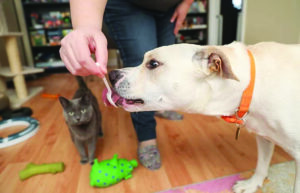
Photo courtesy of Best Friends Animal Society
How should you introduce your cat to a new dog? Slowly and cautiously, monitoring both parties for signs of stress, fear or anxiety. Introductions rarely move forward in a straight line. Taking a step or two backward may be necessary. Successful introductions may take several weeks or even months — and that’s OK.
Separate spaces make good neighbors. Set up a safe, dog-free place — like a guest bedroom or spare bathroom — for your cat. Separate the cat and dog for at least four days (seven is better) to give your new dog time to decompress.
Step 1. Let the cat and dog hear and smell — but not see — each other. Start by allowing one pet to roam the house while the other is confined and then switch. For example, the cat spends time in the house while the dog is in a bedroom or the yard. Then put the cat in her room while the dog explores the rest of the house. This allows your pets to smell each other (under the closed door) and their bedding, and to get used to their noises.
Step 2. Let them see — but not touch — each other. After your cat and dog are relaxed and comfortable smelling and hearing each other, they’re ready to see each other.
Put your dog in a crate in the living area and let your cat approach the crate. If your dog is stressed by the interaction, partially cover the crate with a sheet or blanket. If your dog won’t jump over a baby gate, you could use one as a barrier.
To create positive associations, feed your cat a meal or treats in the same room while your dog eats in his crate. As they become relaxed eating “together,” gradually move your cat’s bowl closer to the dog’s crate.
Keep these sessions short initially, letting the cat and dog spend more time near each other as both pets become more relaxed.
Step 4. Introduce your leashed dog to your cat. When your cat and dog are comfortable being around each other, let your dog meet the cat outside his crate. Start in the common living area with your dog on a loose leash so you can intervene if needed. Let the cat approach the dog — and retreat — at her own pace, according to her comfort level.
Pay attention to both pets’ body language. Your cat should have forward-facing ears, a neutral tail position, and a soft gaze with narrow pupils.
Take a break from the interaction if your cat shows any of these signs of stress:
• Pupils start to dilate
• She freezes or crouches
• Swishes or flicks her tail
• Pins her ears back
Separate the pets (i.e., put your cat back in her room, so she can’t see the dog) if your cat’s fur stands up, or she hisses or growls at the dog (saying “back off, buddy!”).
Your dog should have a relaxed body and neutral tail position (e.g., not too high or tucked). He should pay attention to you when you call him.
Lead your dog farther away from the cat or take a break if your dog:
• Tenses up.
• Moves slowly.
• Fixates on the cat (i.e., won’t reorient to you when you call him).
If your dog barks or lunges at the cat, separate them. After they’ve both relaxed (could take a few days), go back to letting them see each other with a crate between them.
Then resume leashed introductions when they’re ready.
After multiple successful leashed introductions, let the cat and dog spend time together (supervised) with the dog dragging the leash, in case you need to quickly separate them.
Step 5. Reduce the supervision. When your pets are getting along well, you can let them spend time together with less supervision. Start by leaving the room briefly but staying within earshot. Then gradually leave them alone together longer. Your cat must have safe places — a cat tree or shelf — to escape from the dog if needed.
Keep your cat and dog separated when you are away from home, even if they seem to be fine together. Better safe than sorry!

New relationships take time to develop added by whiterocklakeweeklyadmin on
View all posts by whiterocklakeweeklyadmin →