
By David Mullen
In the mid-1980s, the NCAA investigated the Southern Methodist University football program and found multiple examples of “unethical methods of recruiting and retaining players,” including paying players to join or play for the Mustangs from a “large slush fund for payments” earmarked for recruits and players.
The NCAA sanctioned SMU and issued the football program what became known as “the death penalty.” The penalty forced SMU to disband their football program in 1987. It took decades for the program to recover.
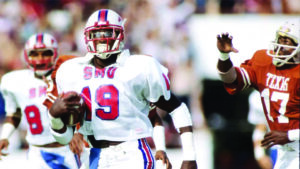
Photo courtesy of SMU Athletics
In today’s NCAA, the mid-1980s SMU football program would not be disgraced but heralded as a model program. That is all one needs to know about the state of college football today.
The term “student athlete,” often used by the NCAA brass, is a misnomer. Football players at the collegiate level are allowed to transfer from school to school for the best financial enumeration. Young men are not in search of the perfect major but looking for a lucrative payday. Now, more than ever, NCAA football is simply a minor league training ground for the NFL. It is NFL Lite.
It used to be that a student could make money working in the campus library but student football players with demanding schedules could not be compensated for their on- and off-field efforts. That archaic stipulation is no longer relevant in NCAA football, but the overcorrection has been extreme.
Bragging rights for schools like Ohio State University, the Universities of Georgia, Alabama, Oregon and Texas and many other institutions are no longer measured by endless tailgate parties and beating longtime rivals. It is a money grab fueled by lucrative television deals and wealthy alumni. Being a student athlete isn’t about maintaining a respectable grade point average and playing for the good of the program. It is about maintaining a respectable NIL (Name, Image, Likeness) agreement while contributing to a program’s revenue stream.
Quarterback Fernando Mendoza played two seasons at the University of California, consistently rated as the top public institution in America. He left for a better NIL deal at Indiana University, because he could. Mendoza transformed the Hoosiers into the No. 1 team in the country and is the leading candidate to win the Heisman Trophy.
A volunteer team of academics, heavily skewed toward the Southeast and specifically the SEC, hole up in a meeting room at the Gaylord Texan in Grapevine to decide which teams play in the College Football Playoffs (CFP), a postseason tournament for the most visible college football programs. Of the 12 teams selected to participate in the 2025 National Championship, nine are from below the Mason-Dixon line. Of the three northern teams chosen (Indiana, Ohio State and Oregon), a case can be made that Bloomington is as southern as Biloxi and Columbus as southern as Chattanooga.
Long gone are the days of the late afternoon New Year’s Day Rose Bowl game, where the champions of the Pacific-8 (or 10 or 12 in other iterations) faced the Big Ten champions. The Pac-12 Conference, which crumbled in 2024 after USC and UCLA led a team exodus for more revenue opportunities in the Big Ten, is being rebuilt with a group of former Mountain West schools. The Big Ten now has 18 teams, perplexing mathematics majors everywhere.
This year, the Rose Bowl is a nondescript CFP quarterfinal game played in the shadows of the wilted flower petals remaining on Colorado Boulevard after Pasadena’s Rose Parade.
The NCAA football champion will not be crowned until Monday, Jan. 19 in Miami. The TV ratings promise to be better on a Monday night in late January than on Thursday, Jan. 1.
College football programs have general managers charged with attracting and paying top talents. Universities depend upon revenue streams from media deals, sponsorships and alumni donations.
Major conferences like the Big Ten and SEC approach $1 billion in annual revenue. Programs like Ohio State, Michigan, Texas, Texas A&M and Georgia are around $200 million in annual revenue apiece.
The winning at all costs mentality has never been more evident since the NCAA began to let Rome burn in exchange for the almighty dollar. One CFP caveat appears to be that legacy teams like Alabama always have a place in the tournament while still preaching the false mantra that any school can win the CFP like small conference champions Tulane (AAC) and James Madison (Sunbelt). The ACC champion Duke was left out of the CFP because tournament integrity would be soiled by the inclusion of a five-loss team.
The NCAA must stop pretending that college football is about “winning one for the Gipper.” It’s about “getting money from the flipper,” the football fan with a remote in his hand sitting in his La-Z-Boy searching through the 36 bowl matchups and 11 CFP postseason tournament games. In 2025, “Rudy” would have a handsome NIL deal.
Coaches are allowed to leave teams in the lurch while padding their own pockets, most recently evident by Lane Kiffin’s departure from Old Miss for LSU and a seven-year, $91 million deal. NCAA football is as professional as the NFL, just with younger players. The NFL couldn’t be more pleased. The league doesn’t have to fund a minor league player development system like MLB, the NBA or NHL.
While trying to rebuild after being decimated for paying players in the 1970s and 1980s and suffering through the repercussions of the death penalty, SMU could not have known that they were being penalized for designing the blueprint for today’s NCAA football programs.

Previous indiscretions encouraged by NCAA added by whiterocklakeweeklyadmin on
View all posts by whiterocklakeweeklyadmin →