
By Christine Rogers
The Dallas Historical Society announces this week the launch of the “Moody Immersive Digital Learning Experience,” a free and permanent augmented reality-driven exhibition that reimagines how Texas history is learned.
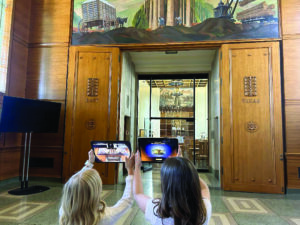
Photo courtesy of Dallas Historical Society
Built like a video game, but designed for learning, the new experience transforms the museum into a multiplayer, scavenger-hunt-style journey where history unfolds through clues, challenges and interactive storytelling.
Using museum-issued iPads, visitors unlock AR content at 44 physical activation points found throughout the museum, including artifacts, murals and statues. Each scan activates videos, narration, 3D models and motion-captured performances. In one example, visitors will meet an ‘AR-ified’ Stephen F. Austin, as he shares a first-person account of his life and death, reflecting on his role as “The Father of Texas” and the ideals that guided his work.
Advanced motion capture and AI-enhanced facial mapping allow visitors to ask questions of the museum’s six bronze statues of Texas leaders who talk back, responding with curated, finite answers and a historically accurate dialogue.
Designed for both classrooms and the general public, the app features two modes: a structured school mode with required questions students must answer, and a free-play mode that functions as an immersive, self-guided tour for families and visitors. The experience is fully bilingual, in both English and Spanish, expanding access for students, families and international visitors.
Different from many other museum apps, the Moody Immersive Digital Learning Experience is fully aligned with Texas Essential Knowledge and Skills (TEKS) and State of Texas Assessments of Academic Readiness (STAAR.) Educators receive detailed post-visit reports showing student performance by TEKS standard, identifying where concepts were mastered and where reteaching may be needed, turning a museum visit into actionable classroom data.
As testament to the exhibition’s potential, Richardson Independent School District has signed as a partner, bringing all 1,536 fourth graders from its 36 elementary schools this year to visit the museum to experience the exhibition. The District and Dallas Historical Society plan to study outcomes that compare students’ knowledge of Texas history before and after their visit, as well as statewide test performance trends over time.
The free exhibition is made possible through a $1,000,000 grant from the Moody Foundation, whose support advances innovative educational initiatives that preserve and share Texas history. The grant ensures an exhibition built with a dynamic content management system so it can evolve over time, allowing Dallas Historical Society to update text, move activation points and rotate content.
“We didn’t want Texas history to sit quietly behind glass,” said Karl Chiao, executive director of the Dallas Historical Society.
“We wanted visitors — especially students — to interact with it, question it and hear it speak back in a way that’s accurate, engaging and aligned with how students learn today. We cannot thank the Moody Family Foundation enough for their generosity and foresight in helping preserve Texas’ history.”
Moody Immersive comes during a global moment for Dallas. With both the Dallas Historical Society and the FIFA World Cup Fan Zone being in Fair Park, the museum is uniquely positioned to showcase Texas history to international visitors traveling to North Texas this summer for the FIFA World Cup.
The permanent exhibition is in the museum’s building at the Hall of State in Fair Park. It opens January 23 to the public and schools during Hall of State’s hours of operation.

Static artifacts jump to life as teachers added by whiterocklakeweeklyadmin on
View all posts by whiterocklakeweeklyadmin →