
By Beth Leermakers
A groundhog shortage isn’t an everyday problem. But with Groundhog Day (February 2) fast approaching, groundhog availability suddenly matters — a lot.
While Punxsatawney Phil, Pennsylvania’s famous weather forecaster, usually hogs the headlines (pun intended), New Jersey’s groundhog crisis is stealing the spotlight.
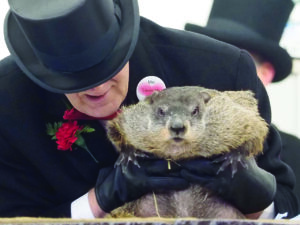
Photo courtesy of NJ.com
Since the death of Milltown Mel in 2021, Milltown, NJ has cancelled its Groundhog Day celebration because they haven’t been able to replace the [forecasting] groundhog.
Why is procuring a groundhog so difficult? Most groundhogs are hibernating in the winter and breeding them is rare. New Jersey rescue groups and zoos haven’t been able to provide a suitable candidate. And event organizers can’t widen their search, since NJ state law bans the import of out-of-state wildlife due to worries about rabies.
The NJ legislature recently passed a bill that would allow limited out-of-state groundhog imports for traditional Groundhog Day celebrations.
However, Governor Phil Murphy vetoed the bill, due to public safety concerns because of the risk of rabies spreading to people or wildlife. In vetoing the bill, Murphy supported the position of the NJ Division of Fish and Wildlife, that expressed concerns about the treatment of groundhogs used in public celebrations. Murphy wrote: “The NJDFW must maintain its focus on protecting and managing wildlife, which includes ensuring that animals are not kept under conditions that infringe on their natural behaviors and environment.”
The fate of the Milltown Groundhog Day celebration is still up in the air, with a few days remaining to find a suitable, NJ-born-and-raised groundhog.
But while today’s celebrations face modern challenges, the tradition itself has far deeper roots — raising the question: why do we celebrate Groundhog Day on February 2nd every year?
Groundhog Day traces its roots to the early days of Christianity in Europe, when Candlemas Day (February 2) served as a seasonal crystal ball. Clear skies signaled a longer winter, while clouds promised an early spring. German folklore later added a furry forecaster to this popular myth; if it was sunny on Candlemas, a badger would cast its shadow, predicting snow into May.
When German immigrants arrived in Pennsylvania in the 1700s, they swapped hedgehogs for the more abundant groundhog. Then, in 1886, a local newspaper editor made it official — declaring Punxsutawney Phil the nation’s premier rodent meteorologist and cementing his place in American folklore.
How many Punxsutawney Phils have there been since 1886? According to the Punxsutawney Groundhog Club, there is only one Punxsutawney Phil.
The group claims that the same groundhog has been predicting the weather for 140 years. How is this possible, when the furry critters only have a potential lifespan of up to eight or nine years? According to legend, Phil’s secret to longevity is an annual summer visit to Phil’s Stump, where a magical “elixir of life” grants him seven extra years per sip. Phil reportedly has a “wife” named Phyllis. The couple welcomed a pair of babies in March of 2024, when Phil became a first-time father.
How accurate is Punxsutawney Phil? The Groundhog Club Inner Circle claims that Phil’s weather predictions are accurate 100 percent of the time. The National Oceanic and Atmospheric Administration NOAA disagrees, saying Phil has only been right about 30 percent of the time over the past decade.
In Texas, armadillos sometimes replace groundhogs as the four-legged forecasters. Frisco’s Groundhog Day Celebration, held at Kaleidoscope Park (6635 Warren Pkwy., Frisco, TX 75034) on Monday, Feb. 2 from 8-10 a.m., features Kaleidoscope Karla, the Park’s honorary groundhog mascot, and a special appearance by a live armadillo (a great selfie opportunity!). Hands-on arts and crafts stations will allow families to create Groundhog Day-themed keepsakes, including wearable groundhog masks, to take home.
Whatever the hedgehog — or armadillo — predicts, let’s hope spring arrives soon.

Fate of Groundhog Day remains uncertain in NJ added by whiterocklakeweeklyadmin on
View all posts by whiterocklakeweeklyadmin →